
At the beginning of the 20th century kindergarten didn’t exist and children went to school at six years old. Third grade, regularly repeated to prolong the scholastic period, ended the only obligatory cycle of instruction.
In 1907 you could attend fourth grade, the following year the fifth, and in 1910 the sixth grade. The numerous classes required the different teachers, often local people, to work very hard and often they preferred to express the most difficult concepts in dialect. Until 1905 each of the young students brought a piece of wood to class to provide their own heat to the classroom. After thoughtful reasoning, the Ruling Board decided to cancel that daily tribute. From far away – 24 kilometers – two or three children arrived at the school in Dosoledo, defying by themselves all kinds of weather. At noon the mothers came to find them and all ate together with hardy appetites on the steps of a hayloft. Very rarely would a family tolerate the shame of not sending their children to school. The children extended their slim Italian vocabulary with terms invented at the moment. The teachers laughed and corrected them, the use of this strong approach made the concepts clearer and the characters more docile. No one ran the risk of talking about it at home: a second and harder punishment was expected. These teachers, custom made for simple people accustomed to make a treasure of every lesson, are remembered with affection and gratitude.
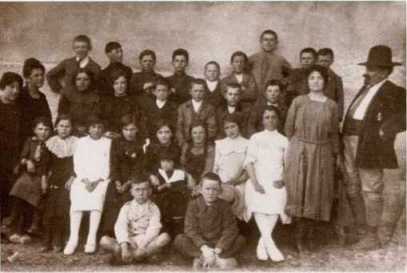
Maestro Massimiliano Mario ed alcune delle sue scolaresche.
 Welcome to Dosoledo / Benvenuti a Dosoledo